Enter your email address:

Delivered by FeedBurner


May 5, 2011

Welcome back to another day in the Pearl Girls Mother of Pearl Mother’s Day blog series.

You still have a few days to enter the contest for a chance to win a beautiful hand crafted pearl necklace. To enter, just {CLICK THIS LINK} and fill out the short form. Contest runs 5/1-5/8 and the winner will on 5/11. Contest is only open to US and Canadian residents.

If you are unfamiliar with Pearl Girls, please visit www.pearlgirls.info and see what we’re all about. In short, we exist to support the work of charities that help women and children in the US and around the globe. Consider purchasing a copy of Pearl Girls: Encountering Grit, Experiencing Grace or one of the Pearl Girls products (all GREAT Mother’s Day gifts!) to help support Pearl Girls.

And to all you MOMS out there! Happy Mother’s Day!

A Mother’s Day Wish by Shellie Rushing Tomlinson

Heads up: Margaret McSweeney deserves a medal, or at least a commendation for giving everyone a much deserved Mother’s Day rest. Okay, y’all can be seated. I’m glad you agree, but you’re supposed to be taking a load off, remember? Oh, and full disclosure—Margaret didn’t know I was going to say that so I hope she leaves it in, and no, I didn’t do it just because I’m ridiculously nostalgic about the theme of her community, although I am. As the Belle of All Things Southern, one who is southern to the bone, I have a thing about pearls.

When I was a teenager, add-a-pearl necklaces were all the rage. They may not be as wildly popular anymore as they were back in the day but I still say they’ll always be a classic concept: a gift of a single pearl on a dainty chain given with the intentions of adding other pearls on important holidays and special occasions. Today, I see add-a-pearls as a beautiful reminder of the accumulated wisdom we learn from our mamas.  Oh, sure, we snicker as young girls because not all of their advice strikes us as useful and some of it seems positively fossilized, but hopefully, over time and with the Father’s blessing, we gain enough perspective to see that these mama-isms—the important values and the silly little lagniappe— are all increasing in value with the years.  By the way, that’s my Mother’s Day wish for each of you, that we’d each take the time and the responsibility to thread these precious heirlooms into treasures worthy of bequeathing to the next generation. Mother’s Day…

May I be honest? I’m looking ahead to the annual celebration with somewhat mixed emotions. I’m not feeling very Mother of the Year. Instead of cooking dinner for my most deserving mama and enjoying her company, instead of reveling in the love of my husband, kids, and grands, (known as the Baby Czars of All Things Southern), I’ll be on the road, touring with my latest book “Sue Ellen’s Girl Ain’t Fat, She Just Weighs Heavy.” I’ve got Mama’s gift bought, wrapped, and ready to be delivered by my beloved hubby, and my grown kids understand that I didn’t choose the release date, but the facts remain:  I won’t be there. (Shameless plugs time, anyone? My daughter blogs at Kitchen Belleicious and is raising funds to build an orphanage in Rwanda at Shelter a Child http://www.shelterachild.com/ and my daughter-in-law celebrates the daily details of getting to know the Holy One at Providence, http://providence-carey.blogspot.com). I won’t get to enjoy Mama tickling the ivory from the piano bench of Melbourne Baptist Church and I won’t be overdosing on baby sugah. Sigh.

But, then, I mentioned mixed emotions earlier, didn’t I? Well, before some sweet soul cues the violin music, perhaps I should lighten up and come clean on what Mr. Harvey would call “the rest of the story.”  It so happens that while the 8th of May will find me miles from home, it’ll also find me in Savannah, Georgia where I’ve secured myself a little reservation at that famous establishment belonging to Mrs. Paula Deen, the Queen of Southern Cooking. Indeed, y’all, I’ll be suffering for Jesus at The Lady and Sons. I know. It’s a dirty job, but someone has to do it.

Regardless of where you spend it, I wish you each a Happy Mother’s Day. I’d love to think that everyone reading my words had a mother like mine, a woman of faith who taught me from childhood of the Risen Savior who saves souls and anchors lives. But, dear reader, if that’s not your past, I hope you know it can be your future. I pray you’ll be the one that begins such a legacy, and that you’ll be moved to start building that heritage today.

I’d love to see y’all on the road somewhere. Watch for me, and I’ll watch for you. I’ll be the one with an empty glass of sweet tea looking, always looking, for a refill.

Hugs,
Shellie

Shellie Rushing Tomlinson, known as the Belle of All Things Southern is a radio host, columnist, author, speaker and founder of the All Things Southern online community, www.allthingssouthern.com. She loves meeting, greeting, laughing and learning with the whole wide world or as many who wander her way. Shellie once dreamed of writing great important things that changed the world, only once she started writing the world grinned and christened her a humorist. Shellie saw this as a problem at first, until she discovered that the laughter softens hearts, builds relationships, and invites her into people’s hurting hearts where she can share her own, which is exactly where she wanted to be all along. Look for Shellie’s latest book, Sue Ellen’s Girl Ain’t Fat, She Just Weighs Heavy wherever fine books are sold.


March 22, 2011


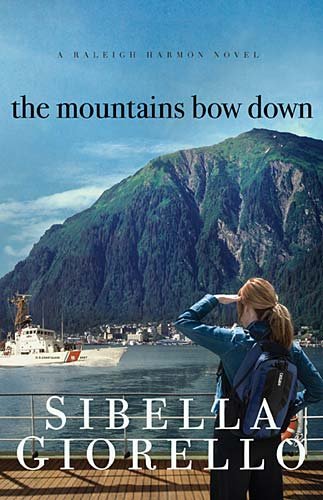
I love to travel, don’t you? In my 20s, I enjoyed wandering the planet as an itinerant English teacher, but these days, I’m thankful if I get to travel a few hours from home. I do most of my globe trekking from the cheap seat of my armchair — and that is why I LOVED reading Sibella Giorello’s latest novel, The Mountains Bow Down.

Why? Because this author whisked me away to the wilds of Alaska! On a cruise ship, The Spirit of Odysseus. Where I got to see glaciers through sentences like this:

Smothered with evergreens, the steeps pointed to a sky so blue it whispered of eternity … And where a liquid silver sea lapped the rocky shore, a bald eagle surveyed the cold water for fish.

*Aah.*

Not only was the setting of this book thrilling, I also thoroughly enjoyed spending time in the mind of FBI agent, Raleigh Harmon, who uses the fascinating field of forensic geology to solve her crimes. And yes — a crime does take place aboard the ship. While most of the passengers are lounging, eating, and gazing at the gorgeous scenery, a woman goes missing and tragedy occurs. In the short span of a 5-day cruise, it’s up to Raleigh Harmon and her Tom Cruise-like sidekick, Special Agent Jack Stephenson, to piece together the mystery and put a monster behind bars.

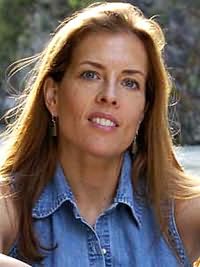
So there’s a little romance on board, though Raleigh isn’t too swayed by Jack’s charm and stays focused on her mission of justice. As I read the book, I kept sneaking peeks at the author’s photo, thinking this book has to be somewhat autobiographical! Sibella Giorello grew up in Alaska and majored in geology. I could imagine her as the novel’s heroine, an FBI agent solving a crime based on microscopic dust fibers. It was so cool to learn how this is done. (Especially since I’m married to a geologist.)

Here’s the back cover copy of the book, if you’d like to learn more:

Everything’s going to work out. Time away always makes things better…

That’s what FBI Special Agent Raleigh Harmon believes as she boards a cruise to Alaska. A land of mountains and gems and minerals, The Last Frontier is a dream destination for this forensic geologist who’s hoping to leave behind a hectic work schedule and an engagement drained of romance.

But when a passenger goes missing and winds up dead, Raleigh’s vacation suddenly gets lost at sea. The ship’s security chief tries to rule the death a suicide, but Raleigh’s forensics background points to a much darker conclusion: Somewhere onboard, a ruthless murderer walks free.

Engulfed by one of her toughest cases yet, Raleigh requests assistance from the FBI and receives her nemesis-perpetual ladies man Special Agent Jack Stephanson. As the cruise ship sails through the Inside Passage, Raleigh has five days to solve a high-profile murder, provide consultation for a movie filming onboard, and figure out her increasingly complicated feelings for Jack-who might not be such a jerk after all.

And that’s only her work life. Family offers even more challenges. Joined on the cruise by her mother and aunt, Raleigh watches helplessly as disturbing rifts splinter her family.

Like the scenery that surrounds the cruise ship, Raleigh discovers a situation so steep and so complex that even the mountains might bow down before it.

I hope you have a chance to read this book, and if you click on the picture below, you also have a chance to win a getaway on your own Alaskan Cruise!

Sibella’s celebrating the release of The Mountains Bow Down with a blog tour, a Cruise prize pack worth over $500 and a Facebook Party! Don’t miss a minute of the fun.

One Grand Prize winner will receive:

  • A $500 gift certificate toward the cruise of their choice from Vacations To Go.
  • The entire set of the Raleigh Harmon series.

To enter click one of the icons below. Then tell your friends. And enter soon – the giveaway ends on 4/1! The winner will be announced at Sibella’s Raleigh Harmon Book Club Party on FB April 5th, 2011! Don’t miss the fun – prizes, books and gab!

Enter via E-mail Enter via FacebookEnter via Twitter

About the Facebook Party: Join Sibella and fans of the Raleigh Harmon series on April 5th at 5:00 pm PST (6 MST, 7 CST & 8 EST) for a Facebook Book Club Party. Sibella will be giving away some fun prizes, testing your trivia skills and hosting a book chat about the Raleigh Harmon books. Have questions you’d like to chat about – leave them on the Event page.


Sibella Giorello grew up in Alaska and majored in geology at Mount Holyoke College. After riding a motorcycle across the country, she worked as a features writer for the Richmond Times-Dispatch. Her stories have won state and national awards, including two nominations for the Pulitzer Prize. She now lives in Washington state with her husband and sons. Find out more about Sibella and her other books at her website. www.sibellagiorello.com


November 30, 2010


I love field trips. Whenever my kids’ school sends home a permission slip for something fun and interesting, I’m there. I ride the bus, bouncing along with other parents, enjoying an excuse to break out of my normal routine and learn something new.

Still, it came as a surprise when I recently got invited to attend an educational field trip — just for me. I was somehow selected to join a group of media attending a conference hosted by the United Egg Producers, held in sunny Tampa, Florida.

I’m not sure why they chose me — perhaps a secret computer at my local grocery store alerted them to the fact that THIS WOMAN BUYS A LOT OF EGGS. It’s true. We eat eggs every day at our house — fried, boiled, or scrambled for breakfast; deviled and sliced for after-school snacks; and baked in all sorts of muffins, cookies, pancakes, waffles, and cornbread.

Eggs fill my kids up and give them energy. They’re also an inexpensive source of protein. Yet I hadn’t given much thought as to WHY eggs are so abundant in the U.S., as well as why I can buy them so cheaply.

We tried for several years to maintain our own free-range, organic egg-laying hens. But eventually we lost every single one of them to predators — neighborhood dogs, hawks, and weasels. In a way it was a relief. Chickens don’t lay forever, and once they age out, you either keep them as feathery pets or … you know, eat them. Which I couldn’t imagine doing.

So I went to Tampa, curious about how modern egg farmers operate. I went alone — with an open mind, a camera, and a little black notebook.

Our group was eclectic: I met other mom bloggers, healthy living writers, cooking experts, and even a senior beauty editor from New York. Everyone was super friendly, and I blended right in, trying to act like I do this sort of thing all the time.

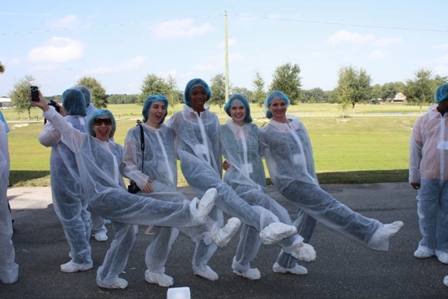
We rode on a bus, actually a van, out to a modern egg-producing farm. Along the way, we listened to speakers and watched a video about how hens create and lay their eggs. Amazing stuff! When we arrived, our van had to be hosed down, and each of us suited up from head to toe in biosecurity jumpsuits. This is why school groups usually aren’t invited to tour egg farms — absolutely everything must be 100% sanitary, free of pathogens.

Here’s our little group, trying to get used to our new outfits (I am on the far right):


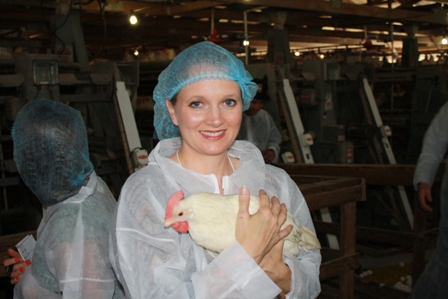
And here I am holding one of these hard-working beautiful white leghorn hens:


I cannot begin to describe to you all the emotions that raced through my body as I entered a barn housing over 100,000 chickens. Mostly, I felt gratitude. I realized I’ve never fully appreciated the labor behind each and every egg I bring into my home.

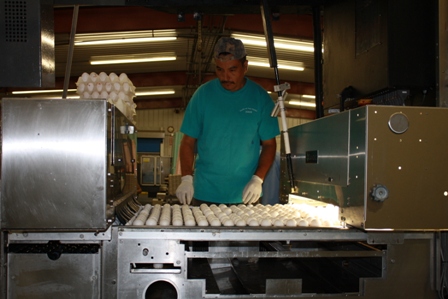
We learned that this facility packages 750,000 eggs per day. It brought back memories of watching “Mr. Rogers” with my children, as I wanted to ask each person working there a million questions. It was fascinating to watch the eggs going from hens to egg cartons within a matter of minutes.


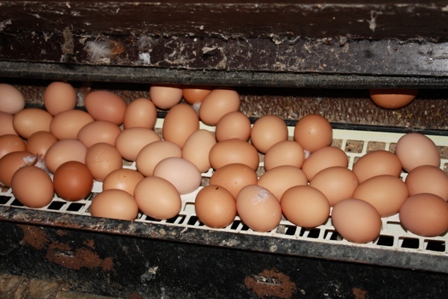
Next, we visited a cage-free farm. Here the hens can roam around freely.


This breed of bird is more docile than the white leghorn, and lays beautiful brown eggs.


After our busy morning of visiting farms, we spent the afternoon listening to professors and other health experts explain the scientific research behind modern egg farming. I learned that the United Egg Producers have created welfare guidelines to ensure that hens have “adequate space, nutritious food, clean water, proper lighting, and fresh air daily.” It’s a voluntary program, and only farms that adhere to these strict guidelines can display the UEP logo on their packaging:


So, after listening to all of these well-informed people and seeing for myself what modern egg farms look like, I came away with one main thought: as consumers, we have plenty of choices when it comes to eggs.

We can buy the inexpensive white eggs that come from caged hens, or we can buy the pricier cage-free eggs. We can buy from local organic farms, or we can fill up our carts at the supermarket. If we have the time, space, and inclination, we can raise our own chickens to feed our families. I encourage you to research all of this for yourself. You can take a virtual tour of a UEP-certified egg farm here.

My special thanks to the United Egg Producers for hosting me on this tour. I learned a lot, made new friends, and gained a greater appreciation of the network of farms and people who work to bring food into my home.

This is definitely a mom’s field trip I’ll never forget.


November 16, 2010

Every year, I read hundreds, perhaps thousands, of picture books, yet I rarely take the time to review them. Usually my eyes are propped open as I mumble my way through “just one more story!” to my two younger kids, who love finding another excuse to stall their bedtime.

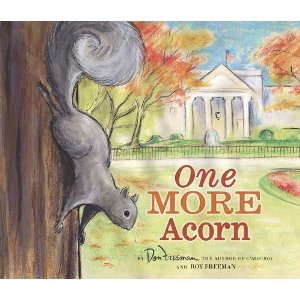
And then a book like One More Acorn comes along, and I feel like I’m holding a little bit of magic in my hands.

The story itself is enchanting. It’s autumn in Washington DC, and a gray squirrel named Earl must scamper through town to find food for his family. He knows he’s hidden a big acorn somewhere, and he’s off to find it. His wife and children are waiting for him in their small blue house perched high on a tree limb.

As we journey with Earl, we see the beauty of our nation’s capital, lit up with the golden colors of fall. The illustrations are bright-hued and yet soft and muted at the same time. Earl happens upon a “Children’s Day Parade” in which children are encouraged to plant a tree.


And here we come to a dilemma: the children see a big acorn that would be perfect for planting — yet it’s also a potential hearty meal for our hard-working squirrel, who has hungry mouths waiting to be fed at home. What will happen to the acorn? Tee hee. I won’t tell you. Go to your library and check it out. (Or buy it if you can’t borrow it.)

Reading One More Acorn gave me a chance to talk about our nation’s capital to my children, pointing out the various monuments and scenic locations in the pictures. But what truly drew me into this book is the Author’s Note at the back of the book.

I usually read these to myself, but that night my kids begged me to read it to them, so I did. Wow. Here’s the story. You know that book, Corduroy, about the little bear who’s missing his overall button? Well, it was written by Don Freeman, who wrote and illustrated many well-known books for children.

Don Freeman died in 1978, leaving behind his sketchbooks, notebooks, and unfinished works in the care of his only son, Roy Freeman. Decades later, Roy discovered the handwritten text and rough sketches of this squirrel book, which his dad had begun in the early 1960s during a trip to Washington DC. Don Freeman apparently abandoned the project after John F. Kennedy was assassinated.

So, thirty years after his father’s death, Roy Freeman found the vision to complete the second half of his dad’s book, enlisting the help of talented artist, Jody Wheeler. The resulting creation is truly a work of art.

I think this would make a wonderful read-aloud book for teachers and librarians, especially as we celebrate the colors of fall and teach children about the change of seasons. From a child’s view, acorns are fun to pick up and collect in coat pockets, but from a squirrel’s view, acorns are food.

One More Acorn is a quiet book. I’m a person who likes to read quiet books to my children. That’s a phrase I learned from author Jane Yolen at SCBWI last spring — she said it’s getting harder for writers to publish quiet books these days. There are no Disney movie tie-ins, flashy pop-outs, or over-the-top humor. Just a quiet story — of a little squirrel, and of a son, finishing up the good work begun by his father.

I’m very thankful we discovered it!


August 27, 2010


We went and saw Eat Pray Love last weekend. I just had to see it, even though I haven’t read the book yet. (I’ve got it on hold at the library, so it should be coming soon.) I was so curious about this story — a woman’s year-long spiritual memoir, as she travels through Italy, India, and Indonesia. Eat Pray Love. What a great title.

The book, which came out four years ago, is a true phenomenon. It’s #1 on the New York Times bestseller list in paperback nonfiction, and it’s made the list for 180 consecutive weeks. The author, Elizabeth Gilbert, has appeared on Oprah Winfrey telling her story, and of course now it’s a blockbuster movie starring Julia Roberts.

But I went to the movie not knowing much about the book, so I confess it was a little messy and confusing for me — real life is never as neat and tidy as fiction. This movie is a woman’s true story — a very brave woman in my opinion, and I admire her for being a writer willing to share it.

The film opens showing us the glamorous life Julia Roberts/Liz Gilbert is leading: she’s a travel writer based in New York who seemingly has it all: a cute husband who’s crazy about her, a beautiful home, career success with travel assignments around the world. What more could she want?

Yet something is amiss — Liz is unhappy. Although it’s not clear in the movie, she apparently doesn’t want to have a baby. She holds her friend’s baby and asks her, “How did you know you wanted this?” and her friend shows her a box full of little baby clothes that she’s kept for years. Liz then discloses that she’s kept this same type of box … full of magazine clips about travel destinations she longs to visit. She’s confused, and so are we, the movie watchers.

Liz decides to divorce her husband, and this bothered me the whole movie. It was the first time I can remember not sympathizing with a main character. I kept wanting her to wake up and realize she’d made a mistake — but she leaves her old life behind to embark on new adventures. She has a fling with an actor, who’s not quite as tantalizing when they’re in the laundry mat, broke, folding clothes together.

So Liz decides to see the world — these three “I” countries, Italy, India, Indonesia, as she explores her inner “I” and tries to heal from the mess she’s made of her life. Here’s something else that confused me — the movie doesn’t make it clear where she gets the money to do this. There was no scene where Liz approaches her agent or editor and snags a six-figure advance (as she does in real life) to finance her travels. The whole movie I kept wondering, “How does she have enough money to do this?” But in reality, she’s been paid up front to write a book.


So it’s a little similar to the Julie and Julia story and movie, except Julie Powell wrote her year-long blog first, which got picked up by a publisher and turned into a book, then a movie. Gilbert’s book idea was sold before she left, then her travels became a book, which became a movie. OK. See, I’m making this easy for you, so you won’t be as confused as I was.

The film itself is gorgeous. I loved traveling right along with Liz/Julia as she experiences the world far from the madding crowd of New York. (And oh, you’ll want to dive head-first into that Italian pasta!) I looked around the packed theater at people of all sizes and ages, realizing most of us couldn’t afford to travel even for a week to one of these countries. Yet for less than 10 bucks, we’re getting to eat, pray, and love our way through three. Pizza and gelato in Italy, silence and prayer in India, and fresh air and romance in Bali. *sigh.*


There are many reasons for seeing a movie, and here’s one where you’ll spend your money to escape, and that’s OK. For all of us scribblers, the fun part is that Liz is writing the whole time — emails back home, journal entries, tap-tap-tap into her laptop, as she’s forming her thoughts into a book. We can relate to this.

One more confusing thing I’ll clear up: the actress Julia Roberts is 42, although the woman she’s playing was only 31 when she took off on her journey. I think that’s an important point. As I watched the film, I personally felt relieved that I’d gotten most of my traveling out of my system in my early to mid-20s before marriage.

So back to that point I made in the beginning — I couldn’t sympathize with Liz who left her husband because she was unhappy. I kept thinking — why didn’t she and her husband travel together? That seems like more fun to me. When I watched Sandra Bullock in The Blind Side, I sympathized with her the whole movie, as did everybody. Liz is a more complex character, that’s for sure.

If you want to find out more nitty-gritty details about the PG-13 rating, check out the Plugged-In review. I definitely wouldn’t take any of my kids to see it. This is a movie you go see on a girls-night-out, in my opinion. But be prepared — the ending is a surprise for those who haven’t read the book.

Which I plan to do very soon!


August 20, 2010


It’s taken me a while to write this post, as I’ve tried to process everything I learned and experienced at Hutchmoot a couple of weeks ago in Nashville. If you’re not familiar with The Rabbit Room, you’re probably wondering what in the world I’m talking about.

The Rabbit Room is a group blog founded by musician/writer Andrew Peterson, composed of like-minded souls who share a common interest in art, film, books, and music as expressions of the Christian faith. After three years of online fellowship, the group decided to congregate in the flesh in Nashville; hence the “hutch” of rabbit roomers holding a “moot” or meeting.

My husband and I decided to attend together, since his brother and a couple of old friends would also be there. And since the date coincided with our 16th wedding anniversary, we thought we’d spend a day at the conference, then a day hiking outdoors, celebrating our marriage.

I signed up quickly (with a little encouragement from Lanier), checking it off my to-do list back in early May, but then I began to feel guilty once I read the news that “the hutch was full” after only a few days. The conference organizers decided to limit the attendees to around 100 people, due to space limitations and to foster a more intimate fellowship. There were people from around the world writing in dismay that they’d wanted to come, but now couldn’t.

Why me? I wanted to know. Why did God open the door for me to go when others couldn’t?

As the date neared, I had major second thoughts. It was the weekend right after my son started a new high school — how could we just skip out of town during his major life transition? My other kids were in the midst of needing me to shop for new fall shoes and other last-minute supplies. Plus, we’d be missing their school orientation as well.

“Maybe we should stay home,” I told my husband at least 20 times.

“No, let’s go,” he said. “You need a break. The kids will be fine.” We’re surrounded by doting grandparents, so childcare wasn’t a problem.

So we went, with me agonizing the whole way there that I’d snagged someone else more worthy’s spot. A serious Rabbit Room contributor, instead of me, who skims posts while taking a break from washing dishes and folding clothes.

I thought maybe I could hide in the back shadows, scribbling a few notes, hoping no one would ask me any questions. There was a reading list, and I never got around to any of the books, save the few I’d read years ago. What if there’s a discussion session? I worried. I’m not in the same league with these people. I wore a black sweater and black skirt, all the better for disappearing into quiet corners.

But here came the surprise.

The Hutch was full of incredibly NICE people.

Everyone I talked to was so interesting, and some were like me, mostly lovers of great literature without any significant works of our own. I met a lady from Texas, who confessed she “blogged a little” now and then, while raising and schooling her children. I got to tell Father Thomas McKenzie how much I enjoy his One-Minute movie reviews, and how I took our kids to see three movies this summer based on his reviews.

I met both Peterson brothers: Andrew and Pete, who put this event together. Andrew kindly signed his two Wingfeather Saga books for my son, including North! Or Be Eaten, which won the Christy award back in June. That assuaged my mother-guilt, since I’d be bringing something home.

We attended sessions discussing the works of C.S. Lewis, George MacDonald, Flannery O’Conner, and Annie Dillard. We listened to Walt Wangerin, Jr, author of The Book of the Dun Cow, give an awe-inspiring Saturday evening keynote address. The Church of the Redeemer, where the conference met, was a gorgeous building, with a sanctuary full of light streaming in through stained glass windows. Every wall displayed unique pieces of artwork. The quiet, candlelit rooms helped me feel less anxious.

I found myself having a great time! I shopped in the Rabbit Room store and picked up two handmade coffee mugs and a stack of beloved new and used books. And the food … the food was out of this world, catered by artist/chef Evie Coates, who made every dish both beautiful and tasty.

We missed a couple of the concerts, and instead of returning for more great teaching and fellowship on Sunday, we headed for the hills of Tennessee, hiking along the waterfalls of Old Stone Fort State Archaeological Park. The sound of rushing water felt like God speaking to me, reminding me how awesome is His love for each of us. Even if we don’t consider ourselves worthy.

More than anything, Hutchmoot helped me have a greater definition of what it means to be a Christian Artist. Pastor Russ Ramsey shared with us a quote from Annie Dillard, who says in The Writing Life: “There is no shortage of good days. It is good lives that are hard to come by.”

I am living the Good Life now. My art may be nothing more than arranging blueberries on top of steaming oatmeal eaten by children who are dashing off to school … but for me, that’s a display of my love, and it’s what I’ve created. I can collect great works of literature and hand them to young growing minds who will outlive me, and will carry the words of these masters into the next century.

That’s what I brought home from the Hutchmoot fellowship.

If you’d like to read what others who were there have to say about it, check out the Hutchmoot Hub.


August 17, 2010

Over the summer, while browsing through my Auburn University alumni magazine, I was surprised to learn that all 4,000 incoming freshmen are being encouraged to read a book together: Three Cups of Tea by Greg Mortenson and David Oliver Relin.


Wow. That’s a major book club, don’t you think?

It’s part of the Common Book program that more than 100 universities are starting to participate in. This reminds me of our own community’s Big Read last spring, when we all read To Kill a Mockingbird together. Can you see how a bookish person likes me gets excited about these types of programs?

So, I had Three Cups of Tea on my mind all summer, wondering what’s so great about it that an entire university would be reading it together. Sure, it was a #1 New Times Bestseller for months, but just because it’s selling millions of copies doesn’t mean I’m going to fall in love with it.

But I did. Oh … there is something rich between the covers of this book that reached the core of me. It’s changed the way I view the world. I hope you’ll get a chance to read it, if you haven’t yet. Especially if you’re a woman. Read it, and you’ll understand.

The story begins with Greg Mortenson’s failure to climb the K2 mountain in Pakistan, the second highest mountain in the world. He almost froze to death one night when the porter carrying his heavy backpacks disappeared far ahead. Greg wandered around lost for a while, and ended up in a village called Korphe.

While staying in this village a while to recover his strength, he was overwhelmed by the kindness and generosity of the people. There were children everywhere, and when he asked the elders where these kids go to school, he got some sad looks.

He discovered dozens of children huddled together in the freezing cold scribbling their math equations into the dirt with sticks. From this point on, he vowed that he would someday return to this village and build them a school.

The book is a page turner. He goes from one hard time to another — living out of his car trying to scrape together his own meager living and keep his dream alive. He writes 300 letters on a rented typewriter until some kind soul shows him how to use the “cut and paste” option on a computer, and then he sends out 280 more. At last he finds a person willing to back him up financially so he can build that first school, Dr. Jean Hoerni.

The rest of the book recounts the trials and adventures Mortenson encounters as he builds that first school in Korphe — which leads to launching a whole organization, Central Asia Institute, dedicated to promoting world peace through education. He builds not only schools, but also relationships with people in the war-torn regions of Pakistan and Afghanistan.


As you’re reading, you suddenly get the big picture that schools lead to educated minds who are less likely to be recruited by terrorists, and who are less likely to strap bombs to themselves and blow things up.

You realize books lead to peace. And so Mortenson’s mission becomes your own.

There’s now a Young Reader’s edition, which has full-color pictures and a simplified text. I think this would be a fantastic book for teachers or parents to read out loud. Students can also participate in the Pennies for Peace program.


The title of the book comes from the way in which the people in central Asia conduct business. Mortenson’s mentor, Haji Ali, teaches him:

The first time you share tea with a Balti, you are a stranger. The second time you take tea, you are an honored guest. The third time you share a cup of tea, you become family, and for our family, we are prepared to do anything, even die.

If you have a few minutes, I encourage you to watch this short interview with Greg Mortenson. You’ll be amazed. I can definitely understand why an entire campus will be reading and discussing this book together, and who knows how many new dreams will be launched from this shared experience.

(I’ve heard the story continues, with the 2009 published sequel, Stones into Schools.)

All photos are complements of Central Asia Institute.


August 16, 2010

I’ve written about this before, but I thought I’d periodically update you on overseas teaching jobs. It’s a topic I feel passionate about, and I’m praying there’s a young 20-something woman out there who might discover my post and find a calling in teaching overseas. It’s one of the best things I ever did for myself.

I’d also like to remind mothers of teenagers there’s a huge world out there, and if their kids work hard, they can see it! I tell my kids this all the time, reminding them they’ll need a good education and work skills in order to have the means to travel.

According to Joy Jobs, there are nearly 5,000 overseas teaching vacancies right now. Recruitment for the 2011-12 school year has already begun, as it takes a while for a teacher to tie up loose ends and move overseas.

These jobs do not require raising financial support; the teachers are paid by the school. I know there are many opportunities for young men and women to go into missions, but most of the time, they require raising support.

I received information today about the following jobs. If reading through this list fascinates you (as it does me!), please contact Joy Jobs. There’s a process where you submit your resume and find out how recruitment works.

***************

LAST-MINUTE POSITIONS FOR IMMEDIATE START!

———————————————————
Málaga, Spain

Tutoring Center in Málaga city is looking for full-time and
part-time Native English Teachers. We are seeking motivated and
well-organized applicants with comprehensive communication
skills.

REQUIREMENTS

- Bachelor’s degree: Education, Languages or related field.
(TEFL and other certificates are valuable).
- Only residents in Málaga or nearby.
- Availability from Monday to Saturday (9:00 – 21:00).
- Previous experience will be valued
- Computer skills: Intermediate (Microsoft Office package,
Proficient in Internet and E-mail)
- Work permit for non EU citizens.
- Candidate needs to be flexible, a fast learner, high spirits,
open minded, and optimistic.
- Fluent in Spanish

SALARY

Negotiable, depending on the candidate skills and
qualifications.

Apply today!
———————————————————

St. Vincent & The Grenadines – Carribean

A Primary School Teacher is wanted for a 10 pupil English company
primary school (Pelican School) on a beautiful small Caribbean
island – Canouan.

It is a wonderful experience for someone seeking an adventure,
looking to enrich their career and life experiences and wanting
to make a difference.

• The successful applicant should have experience teaching at
all levels and must demonstrate commitment to equality and
diversity.
• Having varied teaching experiences, teaching science and
social studies, and also having some knowledge of distance
learning techniques would be an asset.
• He/she will be required to work together with 2 other staff,
teach a class of mixed aged pupils, bring a fresh approach to
this small school of very high potentials and great resources.

Minimum Qualifications:
• A first degree or 5 years teaching experience
• Educational training relevant to your home territory
• A passion for teaching
• Vision and enthusiasm

Families and couples welcome.
We offer accommodation, flights and an attractive salary
package.

Deadline: 10 October, 2010

Unsuitable applications will not be acknowledged

———————————————————

MEF International School – Istanbul

For August 2010, this is an urgent vacancy:

•MS/HS Chemistry/Science

Come live in glorious and historic Istanbul, the 2010 European
Capital and work at an IB World School!
Deadline: 1 September (unless post remains vacant after this
date)

———————————————————
URGENT FULL-TIME ENGLISH TEACHERS IN NORTH VIETNAM

Shelton English Training Centre is one of the prestigious quality
English centers. It has been well-established from the high
reputation of Technology Transferring & Education Development
Ltd., Co founded in 1997. The company has been well-known in the
education and training industry over the past 13 years.

Initially starting business in Hanoi-the capital of Vietnam,
Shelton English Training Centre has been expanding the business
wise to other Northern provinces of Vietnam such as Hai Phong,
Quang Ninh. We are seeking for experienced English native
speaking teachers from England, Australia, America, Ireland,
Canada, etc.

Shelton English Training Centre offers a highly competitive
financial and benefits package to teachers, which is based on
qualifications and experience

If you are serious in teaching and fun loving children then this
is a great opportunity. What are you waiting for, come and join
us!
———————————————————

Abu Dhabi – United Arab Emirates

•Math Teacher Advisor/Curriculum Support Specialist for a boys
middle school in Abu Dhabi!
Be a part of Educational Reform in exciting Abu Dhabi! Assist
the local staff in the implementation of a new curriculum, new
teaching and learning methodologies, and make a difference!

The right candidate will have 5 years relevant teaching
experience and

· Hold a teaching qualification of at least graduate level
· Experienced in curriculum management and development
· Experienced in the use and analysis of performance data
· Sound understanding of innovations in teaching and learning.
· Proven commitment to quality
· Evidence of an ability to understand the ethos of partnering
and of delivering in that environment.
· Excellent English communication skills (both oral and
written)
· Competent in the use of IT and willing to develop these
further
· Respectful and sensitive to local culture and heritage
———————————————————

Government Schools in Malaysia

* English Teaching Professionals as English Language Trainer

From contract period 2011 to 2013 – 3 years

– for primary students
– to enhance the local teachers teaching
competency via co-facilitation and training
– to start in end 2010.

Excellent Benefits and rewards to the right candidate. Malaysia
is a fantastic palce to live.

Application Deadline: 28 October 2010
———————————————————

Kingdom of Bahrain

•English Teachers Required Urgently!

Two experienced English teachers (5-10 years) required to teach
English at middle and high school levels leading to GCSE diploma
in a private school in Bahrain:current strength (300 students)
Knowledge of GCSE curriculum would be an added advantage. Masters
degree preferred but not essential but ability to work in a
highly diverse environment with different nationalities is key to
success. Potential joining date is September 1, 2010 and
therefore speed is of essence. Attractive tax free salary, free
furnished accomodation,leave travel and medical and a two year
fixed contract are available for the most deserving candidates.

Bahrain is one of the most desirable places in the Gulf (GCC
States). Considerable saving potential and no restrictions on
expatriate living.

Apply immediately with CV, cover letter, photo and three
references

———————————————————
Bali – Indonesia!

International School in Bali, Indonesia urgently and immediately
requires a Primary Grade 2 teacher.

Degree in primary education and experienced teachers preferred.

Apply ASAP!

By: Heather Ivester in: Education,Travel | Permalink | Comments & Trackbacks (0)


August 3, 2010


I’m happy to welcome Hester Bass as my guest today. If it’s possible to fall in love with a picture book, I fell head over heels for Hester’s award-winning book, The Secret Life of Walter Anderson. I think you will too, when you hear the story behind it!

Hi Hester. I loved your book! Can you tell us how you got the idea to write it?

Thank you, Heather! This book did percolate for a long while. Here’s the scoop. In the early 1980s, my husband Clayton and I were introduced by a Mississippi friend to the work of Walter Anderson, and we were captivated by his broad range of work and adventurous life.

We first saw an exhibition of his work in the mid-80s in Columbus, Georgia and then in 1992 we visited the Walter Anderson Museum of Art (WAMA) in Ocean Springs, Mississippi. Anderson’s work seemed to vibrate with intensity, we were transfixed by the murals, and the town of Ocean Springs with its warm friendly people and main street lined with ancient live oaks charmed us instantly.

In 1996, my husband accepted the position of executive director of WAMA and we moved our family to Ocean Springs. I got to know the extended Anderson family, learning more and more details about this extraordinary American artist. I performed as a storyteller then and told Anderson’s life story to the school groups who visited WAMA. The children really leaned into the tale of a man who rode a bicycle instead of driving a car, who could draw with a crayon as expertly as with pen and ink, and who had a special relationship with nature.

Wow! I can see how kids are drawn to his unique personality.

I was absolutely compelled to tell the story of a man who lived under his boat on the beach of an uninhabited island, sometimes eating whatever washed ashore, so he could capture in words and pictures the beauty of the Gulf Coast. I wrote the first draft in 2001, sold the manuscript in 2006, and the book came out in 2009 — but, in a way, it took me over 25 years to write this book.


It was definitely worth the wait! In light of the recent Gulf oil spill disaster, what do you think readers can learn from the life of Walter Anderson?

Although Walter Anderson was widely traveled, most of his art represents what surrounded him every day — pelicans, dolphins, and turtles right down to the lizards, dragonflies, and shrimp — and everything he loved on the Gulf Coast has been threatened by this oil spill. It is an unfathomable tragedy, likely to have even more long-term effects than Katrina.

Walter Anderson was as much as naturalist as an artist and a keen observer of nature. He was among the first to sound the alarm in the 1960s against the effects of DDT on the pelicans, since he saw that something was thinning their eggshells and threatening the species.

I didn’t know that about DDT and pelicans. That sounds scary.

Walter Anderson spent his life striving to bring art and nature into one thing, and I think he succeeded. When I look at his art, the vibrancy of the image draws me in and l have a new appreciation for whatever he is showing me. While I hesitate to place a meaning on anyone’s life or art because every reader or viewer brings his or her own interpretation to bear on the work, I can share the meaning that Walter Anderson’s life speaks to me: get outside and experience the infinite beauty of the natural world.

This is especially important for children. The environment and way of life of the American Gulf Coast are treasures that must be preserved and protected for all to enjoy, and I hope stricter safety measures will be placed in effect to secure greater safeguards against environmental degradation in the future.

I agree. In your book, Walter Anderson often visits Horn Island. Where is this island located? Have you ever been able to visit it?

Horn is a barrier island about twelve miles off the Mississippi Gulf Coast. The only way to get there is by boat. I’ve been there several times, and it truly is a magical place that makes me feel I am at the edge of the world. It’s now part of the Gulf Islands National Seashore and a ranger lives there, but Horn retains the feel of an uninhabited island. There’s no dock so you pull into the shallows and wade ashore as the fish and crabs scurry out of your way. Very quickly though, if you are still and quiet, nature closes back in around you and one begins to realize the appeal of such a place for an artist.

Anderson wrote that he wanted to become a part of nature and not an interruption to it, and this is possible on Horn. Yes, the temperatures can be extreme and the insects are legendary, but Horn is one of my favorite places in the world.

Oh, you make me wish I could go there! Your text goes along beautifully with the amazing illustrations of E.B. Lewis. How did the two of you get matched up to work together?

One of the biggest misconceptions about writing for children is that authors and illustrators work together; usually they don’t talk about the project at all, much less meet, but this case was different. My fabulous editor at Candlewick Press asked my opinion regarding an illustrator, and I felt E. B. Lewis was a superb choice; he’s a gifted watercolorist and someone whom I felt would understand Walter Anderson’s journey as an artist. We met at a conference in 2007 but didn’t talk about the book; we just got to know each other a bit. I learned it was his habit to use photographic references and that he posed models and props to achieve the look he wanted.

In July 2008 I received an invitation to accompany him to Ocean Springs, Mississippi since I knew the people and could help him gain access. We spent a very busy but very fun week in Mississippi, and two of Walter Anderson’s children graciously posed as their parents. His other two children offered their support with locations and getting us to Horn. Many people on the coast have commented to me that E. B. really captured the light and the water accurately, both hallmarks of E. B.’s gorgeous paintings.

Yes, the water is painted so beautifully in the book.

Luckily folks will soon have a chance to see those paintings for themselves in an exhibition called “Creating The Secret World of Walter Anderson” that will open at WAMA in September 2010 and then tour other museums. The show will feature the sketches, photographs, and other aspects of the preliminary work; all the paintings used as illustrations in the book; and originals by Walter Anderson. I’m excited to see all this in one place myself!

I hope this exhibit will travel to a museum near me — I’d love to take my family to see it. Were you surprised when your book won the “Orbus Pictus Award for Outstanding Nonfiction for Children?” What is this award all about? Has it opened any doors for you?

Oh my goodness — yes! — “surprised” is an understatement. The annual NCTE Orbis Pictus Award for Outstanding Nonfiction for Children is given by the National Council of Teachers of English, established for “promoting and recognizing excellence in the writing of nonfiction for children” following the literary criteria of accuracy, organization, design, and style. It’s a big deal, to say the least!

I happened to meet the chair of the Orbis Pictus Committee at a conference in New Orleans in November 2009, and she mentioned that she had seen my book and liked it. Well, I was thrilled just to know that the committee was aware of it! The NCTE was set to announce the award on the same day in January as the ALA awards — the American Library Association announces several awards that day, including the other national award for children’s nonfiction: the Sibert Medal — so that day was marked on my calendar as it is every year since it’s considered the “Oscars” of children’s literature. (One hopes but one does not expect, if you know what I mean. ;-) )

The weekend before the announcement I was at a book festival in Texas — Beauty and the Book — rooming with the lovely and talented Kerry Madden. After a very full Friday, I checked my e-mail about 11:30 at night and found one with the simple subject “news” from the Orbis Pictus committee chair.

She said that knowing I was out of town and that ALA’s conference was in Boston — meaning that likely everyone from Candlewick Press was there — she thought I might not hear the “news” in a prompt manner so she suggested I visit the NCTE website since it had been updated a little early. “Congratulations!” she said. Hmmm. When I clicked the link and saw my book cover load in, I screamed — you can check with Kerry — and whooped and hollered with joy! Then I started making the phone calls — yes, at nearly midnight — which continued into the next day.

I really can’t describe the exhilaration of that moment. An award like the Orbis Pictus brings so much attention to the book — and thus to Walter Anderson and his incredible art — that I could never accomplish on my own. I am so deeply grateful, and look forward to thanking everyone in person when I accept the award at the NCTE conference in Orlando in November 2010.

That’s true — all the attention your book gains will help increase awareness of Walter Anderson’s life and work. On a different subject, when I’ve heard you speak at SCBWI conferences, you seem to have a heart for encouraging new writers. What advice would you offer to a writer who has a dream on one day publishing books for children? Is it worth the ups and downs and all the risk?

To answer your second question in a word: yes. It’s worth it. Writing, as any creative pursuit inevitably does, involves the risk of exposing some of your inner life to the opinions of others, which can be very tough to bear. You have to want to write, to be published, to promote, to work hard on every aspect and understand that writing is an art but publishing is a business.

You have to want to succeed and “keep your eyes on the prize” because along the way there will absolutely be setbacks, criticisms, and disappointments to be sure. But. If you work very, very hard to put only your very, very best work in front of an agent or publisher, dreams can absolutely come true; I am living proof.

You’re right, I do love to encourage new writers. I remember very well what it was like to be one because I still am a beginner. I learn new things about myself through writing every day and hope to never lose that beginner’s mind and enthusiasm.

My advice for the dreamers: Go for it. Read constantly, especially in the genre of books that you want to write. Read books on the craft of writing and discover how you work best. Attend conferences to network with writers and be critiqued by professionals. Get out and meet people who love stories — librarians, teachers, and booksellers.

Deconstruct favorite books to see how all the pieces fit together. In my opinion, it is much more important in the beginning to spend time polishing your work until it shines than to spend your time submitting work that is not ready. The greatest mistake most beginners make is to submit a manuscript to an editor or agent before it is the best it can possibly be.

Competition is fierce, but a finely crafted story with vivid characters and a snappy plot that hooks a reader and won’t let go is what every editor is looking for.

Thank you for all of this advice! You’ve encouraged the dreamer living in all of us. Hester, is it true that you once appeared on the TV game show, “Who Wants to Be a Millionaire?” What was that like? Did you get really nervous or was it mostly fun?

I’ve actually been on two TV game shows and let me tell you, it was fun fun fun! I was on “The $50,000 Pyramid” with Dick Clark when I lived in New York back in 1981. I won a pen and pencil set, some car wax when I didn’t own a car, and some towels. My game went to a tie-breaker and I lost by a few seconds so I didn’t get to the Winner’s Circle.

Then after two-and-a-half years of trying to get on the show, I returned to New York in 2002 to be in the Hot Seat on “Who Wants To Be A Millionaire” in its first season of syndication with Meredith Vieira. I had been writing for a year or so but needed a cash infusion to get serious about it — attend conferences and such — so this would be, as they say, “life-changing money” for me.

What a dream come true!

Being a game show contestant is definitely nerve-wracking, but I’ve been an actress and a singer and was somewhat accustomed to the pressures of performing in front of an audience. Still, being in the Hot Seat is a unique experience — one mistake and you’re out. I relaxed a bit once I’d used all my “lifelines” at $16,000; then it was just me and the questions.

I successfully reasoned or just plain guessed my way to the $250,000 question, and when I saw it was about “Star Trek” I thought I had it for sure — but it was something that was never on the show. Play along!

Lt. Uhura’s name comes from a Swahili word meaning what: Heaven, Freedom, Travel, or Justice. I felt sure it wasn’t “Heaven” or “Travel” but I couldn’t choose between “Freedom” (the obvious answer, I thought — too obvious) or “Justice” (which could also fit the times and the character) so I had to walk away with $125,000. Whee! I couldn’t sleep until I got back home.

That’s still absolutely amazing!

Oh, and the answer? My guess would have been “Justice” and it would have been wrong: the answer was “Freedom.” I’ll never know what my last two questions would have been, and you know what? That’s okay, I’m happy. :-)

I can see why — you still came home with plenty to get you to that first writer’s conference. One more question — what’s next for you? Are you working on another book or planning a new adventure? Do you still want to be in a movie and go visit New Zealand?

Next up: I’m going on tour again to appear at bookstores and speak at conferences. I’ve got some school and library visits on my calendar. I’m thankful to say the book also won the 2010 SIBA Book Award for Best Children’s Book given by the Southern Independent Booksellers Alliance, so I’ll be headed to their conference to thank all the marvelous book lovers who keep independence alive.

Congratulations!

Of course I still want to be in a movie (hint, hint to Christopher Nolan — my favorite director!), and New Zealand is the #1 place I want to visit (all those locations from the Lord of the Rings movies — wow!) and my list goes on and on.

I am always writing new stories but I don’t like to talk about them until I have a signed contract; then I can barely stop talking about them. Look for more nonfiction — especially picture book biography — and I hope to break into fiction. I’m writing/ rewriting a novel. So I better get back to it.

Thank you so much for taking the time to share with us, Hester, You’ve inspired us with our own writing journeys!

Thank you for inviting me to your blog.

Please visit Hester Bass at her website to learn more about her and her wonderful books. I love this quote she shares from Walter Inglis Anderson:

“True art consists of spreading wide the intervals so that imagination may fill the space between the trees.”


July 27, 2010

Today’s guest is Meredith Efken, who has written a fascinating novel about adopting a child from China. I’d love to share her book with someone who is interested in this topic. Please leave a comment below or email me privately, and I’ll draw a name on Friday to win LUCKY BABY. [Update: Congratulations to Laura! She won the free copy of this book!]


Hi Meredith. I was excited about reading your book because I know several families who’ve adopted daughters from China. Can you tell us about your inspiration for writing LUCKY BABY?

In 1999, my husband and I adopted our oldest daughter from China. She was fourteen months old, and neither she nor her new parents had the faintest clue what to do with each other. Becoming a family, with the addition of our second (non-adopted) daughter three years later, was this miraculous, inspiring, and sometimes heart-breaking journey. I wanted to write about that journey — not just the usual “orphan finds family in happy-ever-after ending.”

The adoption became the hook for the story, but what I really ended up exploring was the process of becoming a mother — that process of being broken, being shaped, of dying, living, of losing all control over your heart because it doesn’t belong to you any more — and how thrilling, and frightening, and painful it all can be.


Your novel gave me a lot of new insight into the emotions involved on both sides of adoption. How much of Meg and Eva’s story was similar to you and your daughter’s?

Much of it is quite different, actually. My daughter was much younger than Eva when we adopted her, and she didn’t have any physical disabilities (even though we’d been told she did.) Eva’s attachment problems are also far more severe than anything our daughter has experienced, though some of the questions and internal conflict about birth parents and adoptive parents — and their roles in her life — are ones that are very common not just for my daughter but for many adopted children everywhere.

My own family and upbringing, as well as my husband’s, are drastically different (and much more positive) than those of Meg and Lewis in the story. That’s been one of the interesting things about this novel and people’s reaction to it — I must have hit a lot of the emotional notes correctly, because many people assume the story is a lot more autobiographical than it is.

But I did draw on some of my own insecurities and fears about parenting, as well as the stories and experiences of many, many mothers — both adoptive and not. Even though the emotions in the story are not always from my own experience, they are the experiences of many other families. I hope the truth of those experiences comes through in the book.


What made you decide to focus on such a difficult aspect of the adopting experience? (i.e., attachment disorder). Is this common, especially for families who adopt an older child?

Well, first, let me just adjust the question a bit. “Attachment disorder” is a specific psychological disorder that can affect any child who has been neglected or undergone trauma as an infant or toddler — not just children who are adopted. A psychologist can evaluate a child for RAD (Reactive Attachment Disorder) and recommend therapy and support for the child and the family, but it is definitely a challenging and difficult disorder to work with.

However, RAD is distinct from having problems adjusting to a family or problems developing attachment after an adoption. I think it’s not an either/or situation — RAD or no problems at all. There is a wide range of experience between those two extremes. Not every child who struggles to adapt to their adoptive family has RAD. And not every child who is adopted has attachment problems — no one really understands what causes some children to struggle while others seem to have no problems at all. It’s very complicated.

That said, nearly all adopted children do have struggles unique to the adoption experience. They’ve all experienced a trauma early in life — that of losing their birth parents, even if they can’t remember it. There is a grief process they must go through to deal with that loss. Additionally, a child who has been in an orphanage or foster family experiences loss a second time when they go from that placement to their adoptive family. Even though the adoption provides the benefit of a stable, permanent, loving environment, the loss of the familiar is still traumatic.

That double loss has consequences. It affects a child in often-profound ways. So I chose to write about that, showing one child’s process of grieving and coming to terms with her loss and the impact that has on her family and friends. I don’t consider Eva to have actual RAD. She has experienced deep loss that is far bigger than what she can process on her own, and so she does end up needing the help of a therapist to work through those issues before she can really integrate into her new family.

The process of grieving for what has been lost and then moving forward with a new family looks different for each child. Some children have a much more difficult time than others. Some seem to adjust fine in childhood, but will have to deal with their grief as adults. Others seem to come through it all very smoothly at a young age and are fine. I don’t think that the age of the child at adoption necessarily impacts their attachment or adjustment by itself. My understanding is that there is an entire range of factors that can impact how a certain child reacts to an adoption.

It’s something all adoptive parents need to be aware of, but not fearful of. Adopted children — especially ones who have been in an institutional setting like an orphanage — by the very fact of being adopted have special needs that their new parents have to be prepared to deal with.

Getting support early and being patient, educating themselves, and being committed to the process for as long as it takes are what adoptive parents need to plan on if they choose to adopt. It’s not always easy, but the good news is that the vast majority of adopted children do adapt, and do go on to have very productive, healthy lives. There is a lot of support and a lot of hope available to families who are working through this process.

Thank you, Meredith, for all of this valuable information! While reading your book, I really felt like I was visiting China. You describe the sounds, smells, and sights that take your reader there. How did you learn so much about China? What is your favorite place to visit?


We traveled to China for the adoption in 1999. We spent a couple days in Beijing, about a week in our daughter’s birth city for the adoption, and then about another week in Guangzhou, to go through the immigration process to bring her home. Much of my description of China was based on that trip, including our short tour of our daughter’s orphanage.

When I needed to fill in all the many gaps in my knowledge (since two weeks is hardly enough time to really understand a foreign country), I went to a variety of sources, including blogs of expats living in China, some Chinese friends living in my city, videos on YouTube, and other adoptive families. The hardest part was portraying life in a private Chinese home in China, since I haven’t had the opportunity to actually visit anyone’s home in China.

I found videos on YouTube of people in China getting together with friends in their homes, and I also used real estate listings to see photos of the interiors of various homes in Shanghai. I did a lot of reading about how they celebrate holidays such as Chinese New Year, what foods they eat — like for breakfast — and from there I used my imagination.

My daughter and I traveled back to China last summer (2009), and I was amazed at the difference 10 years has made in the nation. I had to make some last-minute adjustments to my book based on that trip because the country as a whole has become so much more developed over the past decade.


My favorite place I’ve visited is definitely Kunming, in Yunnan Province. The weather is beautiful, the people are friendly, and Yunnan is home to over half of the ethnic minorities that live in China, so the cultural heritage is extremely rich. Plus, they have some beautiful parks and lots of flowers. The food is amazing, too.

You mention Chinese phrases often in your writing. Have you studied the Chinese language? In your book, parents Meg and Lewis want their daughter Eva to retain some of her cultural heritage by learning Chinese. Do you think it’s a good idea for children adopted from China to keep in touch with their native language in some way?

I have studied Chinese just a very little bit. It’s a beautiful language, and not nearly so hard as it has a reputation of being. We’ve got classes in our city that are specifically for adoptive families, but due to our daughter’s dance schedule (she’s intensely pursuing ballet as a possible career) we haven’t been able to make the Chinese classes.

Most of the phrases in the book were either translated for me by Chinese acquaintances or were taken from phrase lists for adoptive families on the internet.

I think children adopted from a different culture should always be offered as many opportunities as possible to learn about and interact with that culture. But each child’s level of interest in doing so is going to be different. I don’t think it’s good to force it on them.

As far as language-learning goes, I think it’s a good idea if the opportunity is there. But realistically, unless the adoptive parents are fluent in the language and use it regularly at home, a child isn’t going to become bilingual or even fluent just by weekly language classes. The exposure to the language is good — it’s good for any child to learn a second language. Learning Chinese is an especially good idea right now, considering that it is becoming a more dominant force globally.

I confess I got hungry for Chinese cuisine while reading your book. It’s full of references to delicious food! What is your favorite Chinese food? Can you find it where you live in the U.S.?

I have to say — if all you’ve experienced of “Chinese food” is in a Chinese restaurant in America, you are missing out. Real Chinese food is completely different — a tremendous variety of flavors and ingredients (a few are far too exotic for my comfort!). It’s quite an adventure!


Some of what I like best in real Chinese food (which varies greatly by region of the country) are the simple dishes — the stir-fried green beans or the mushrooms. I even had a friend in the States once who stir-fried spaghetti squash and sliced sweet peppers, and it was heaven. They don’t actually use such thick sauces as the restaurants here do. The sauce is generally more broth-like, and it lets the flavor of the vegetable really come through.

I also like the dumplings and stuffed buns — which they do serve in some parts of China, though I don’t think it’s quite as common as the dim sum restaurants in our American Chinatowns are.

We had one dish in Kunming during our 1999 trip that I’ve been dreaming of ever since. It was called Yunnan Flavor Soup, though I think it may be called “Over The Bridge Soup” in other parts of the country. The waiter brought us super-heated broth, and a tray of raw meat slices (I wasn’t a vegetarian at that point) which we cooked in the soup broth itself. Then we added vegetables, noodles, and what I believe was a quail egg. The broth cooked all of it, and it was simply delicious–and so much fun to assemble and “cook” it ourselves.

I have not been able to find a recipe for it or any restaurant that makes it, but if anyone knows of a recipe for it, I’d love to have it.

Throughout the book, you weave in certain symbols, such as ladybugs, dragons, and a dream-like Chinese woman who appears at various points in Meg’s journey. Can you tell us how you got interested in writing using magical realism? How do you think it adds to the story?

I really struggled in writing this book to adequately express the sense of wonder and the miraculous nature of the adoption experience. Plain old prose just didn’t seem to do it, and it was quite frustrating from an artistic standpoint. I’d been reading about magical realism as a genre, and it intrigued me conceptually — the writers attempt to flip-flop reality by portraying the fantastic as normal and the mundane as magical — but much of classic magical realism is darkly political in nature and didn’t really appeal to me.

Then I came across some women writers of magical realism, such as Isabel Allende, Sarah Addison Allen, and Alice Hoffman, and their blend of women’s fiction with magical realism techniques really appealed to me.

What the magical realism did for me in writing LUCKY BABY was to make it possible for me to convey the mystical and miraculous journey of the heart that is adoption. It also was a way for me to express my view of faith. As a Christian, I find that my faith is mystical, a bit fantastical to some, and rooted in the supernatural — and yet, it impacts my daily life in ways I nearly take for granted. And at the same time, that faith gives me an appreciation and a wonder for the most mundane of human experiences — eating good food, the beauty of a perfect sunset, the personal connection of one hand holding another. Magical realism seemed a perfect reflection of how I experience God at work in me, so I wanted to try it in this story.

Do you have any advice for families who are interested in international adoption? Are there any organizations you’d specifically recommend? Is it helpful to join an online support network when someone is merely exploring the option?

Don’t rush into it. Count the cost — not just financially, but also in terms of time, emotional energy, and the level of effort involved in caring for a child that has been institutionalized. There are challenges and difficulties that are unique to international adoption, and parents have to be prepared to love their child no matter what — even in the unlikely event that the child can’t love them in return.

I’ve had people suggest that by adopting, we took the easy way out because I didn’t have to go through pregnancy and delivery. And after having been pregnant as well, I can say that physically, adoption is much easier. But adoption has deeply emotional ramifications, and there are no guarantees that it will go smoothly. So long term, I think adoption is harder for parents. They’ve got to be prepared for that and willing to be that rock for their children when it gets hard.

If parents aren’t sure they can do that, then it’s better for them and for the child not to adopt. But if they are willing to take on the challenge and uncertainty, I think they’ll find that the adoption journey is amazing, beautiful, and well worth it all.

Definitely join an online or in-person support group at any phase of the adoption process. There’s so much to learn. It’s hard to list any websites these days because there are so many really great ones, but one of the longest-standing ones and most comprehensive is RainbowKids.com

Was it difficult for you to make the transition from humorous mom-lit to this novel, where you sometimes write from a Chinese orphan’s point of view? How did your creative coach help you in this process?

It wasn’t the transition that was difficult — because I knew I couldn’t personally manage to make this story a comedy. You have to have a certain amount of distance and perspective to write humorously — at least I do. And I realized early on that I had no distance and no perspective whatsoever when it came to writing about Chinese adoption. It’s why it took me eight years just to decide to write it at all.

The emotions run so deep and strong for me, and my own expectations were so high for doing it well, that it actually crippled me for awhile as I was trying to write. This is where my creativity coach stepped in and was an invaluable part of helping me get past the expectations and self-doubt. She helped me identify exactly what was holding me back from being able to write, and then came up with mental exercises and techniques for dealing with those doubts or concerns. It was all very simple stuff, but it was very effective in helping me get my confidence back.

But there were still parts of the book that were incredibly difficult to write — won’t say which ones here because it would involve spoilers for the plot. There’s a quote about writing by Walter Wellesley “Red” Smith: “There’s nothing to writing. All you do is sit down at a typewriter and open a vein.” I have no idea who he is and I’ve never read his work, but for the first time in my writing career, in writing LUCKY BABY I found the truth to his statement.

The act of emotionally “opening a vein” as I wrote was terrifying and painful, but also exhilarating. It stretched my writing skills in a way that wouldn’t have happened with comedy — as difficult as comedy actually is. So from an artistic standpoint, it was thrilling to have a chance to grow and write something so different from what I’d done before.

In writing LUCKY BABY, a novel about an American couple adopting a child from China, what was the most important message you wanted to convey?

I wanted to show the complexity of international adoption — the beauty and hope, but also the difficulties. It’s not a fairy tale where the rich American swoops in to rescue a foreign orphan and takes them away to a happy-ever-after life, or where the lonely, childless couple has their dearest wish come true.

Adoption is a beautiful, hope-filled way to build a family, but the hard truth is that it is built on a tragedy — the separation of a child from its birth parents. And there are always consequences of that tragedy that families will face. With international adoption, you have the added challenges of the loss of the child’s birth culture. I wanted to present these issues honestly because this is not a fairy tale.

Becoming a family is a long journey and it can be a hard one. But at the same time, I wanted to show the hope and beauty and healing that the adoption journey can bring as well.

Meredith Efken is also author of the critically acclaimed SAHM I Am series that traces the friendship of a group of stay-at-home mothers through their emails to each other. In addition to writing, Meredith owns the Fiction Fix-It Shop, which offers freelance fiction editing and writing coaching.

P.S. Don’t forget — if you’d like to enter your name to win a free copy of Meredith Efken’s LUCKY BABY, leave a comment below or email me at the address to your left. I’ll draw a name on Friday and will contact you for an address to send this amazing book!